Recording of the IRDR webinar, "Transboundary Disaster Risk Reduction: Implications of the China–Nepal Flash Flood of 26 August 2026"
The Integrated Research on Disaster Risk (IRDR) programme, in partnership with the UN Office for Disaster Risk Reduction (UNDRR), convened an urgent virtual webinar to dissect the catastrophic flash flood and debris flow that devastated the Nepal–China border region on 26 August 2026, and to chart a practical pathway for enhanced transboundary resilience in the Hindu Kush Himalaya.
The 90-minute webinar, titled "Transboundary Disaster Risk Reduction: Implications of the China–Nepal Flash Flood of 26 August 2026", was held on Thursday, 3 September 2026 and brought together a distinguished roster of experts and practitioners to analyse the event's complex dynamics and identify concrete actions to reduce future risk.
The concept note for this webinar can be read here.
An Unprecedented "Himalayan Tsunami"
On 26 August 2026, a massive ice-rock avalanche in Nepal triggered what scientists described as an unprecedented "Himalayan tsunami"—a complex, cascading hazard unlike any historically recorded in the region. The falling mass released energy equivalent to a magnitude 5.2 earthquake, melting ice and entraining water and debris as it descended. The resulting surge generated wave heights of 50–100 meters and velocities of 180–190 km/h, traveling over 160 kilometers downstream.
According to a rapid analysis report by IRDR young scientists in Nepal, the failure likely blocked the river and formed a temporary natural dam before breaching around 8:30 a.m. on 26 August. The steep gradient and narrow valley further accelerated and concentrated the flood, while the heavy debris load increased its destructive force
The disaster resulted in over 1,200 confirmed deaths, with more than 4,000 people reported missing, widespread destruction of infrastructure, and severe disruption of cross-border trade and tourism. The flood destroyed roads, more than 30 bridges, communication networks, and hydropower plants with a combined capacity of approximately 748 MW. Most hydrological monitoring stations in the affected area were swept away, severely limiting data collection and real-time assessment.
Seven Minutes That Changed Everything
Scientific briefings from researchers working on-site since the disaster's onset—including Er. Suraj Gautam, Executive Director of the Institute for Himalayan Risk Reduction (IHRR), the host institute for the newly designated IRDR ICoE on Interdisciplinary Research on Himalayan Risk and Resilience (IRDR ICoE-IHRR), and Dr. Wang Hao of the Institute of Mountain Hazards and Environment (IMHE), Chinese Academy of Sciences—confirmed the event's extraordinary characteristics.
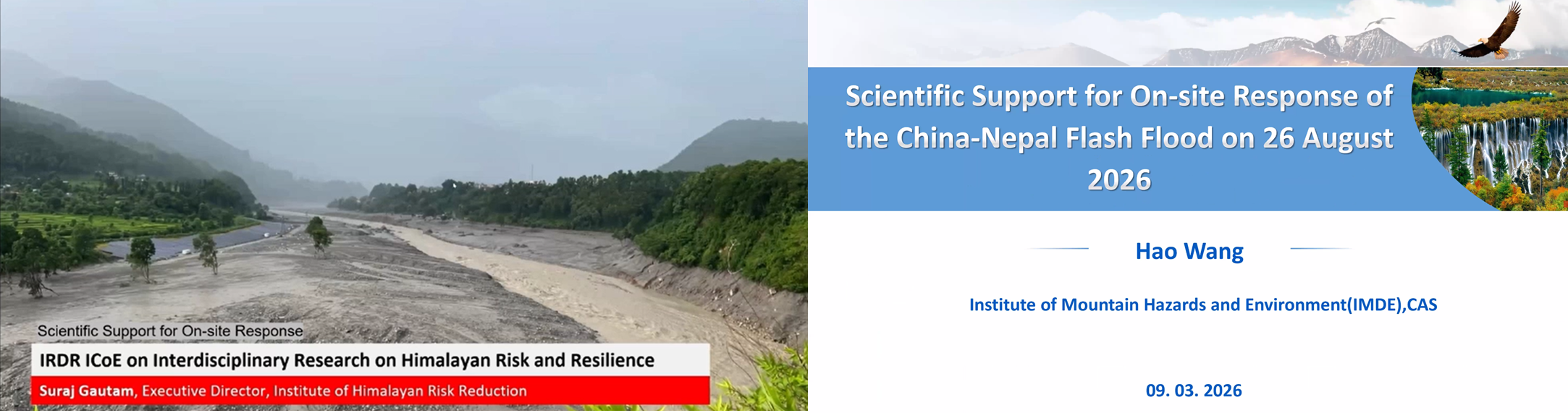
The surge took only seven minutes to travel 22 kilometers from its origin to the China–Nepal border. This extremely short lead time rendered traditional flood forecasting and community response mechanisms largely ineffective. The formation of temporary barrier lakes upstream created continuing secondary disaster risks, prompting scientists on both sides of the border to conduct 24-hour UAV monitoring and slope stability assessments.
Systemic Gaps Laid Bare
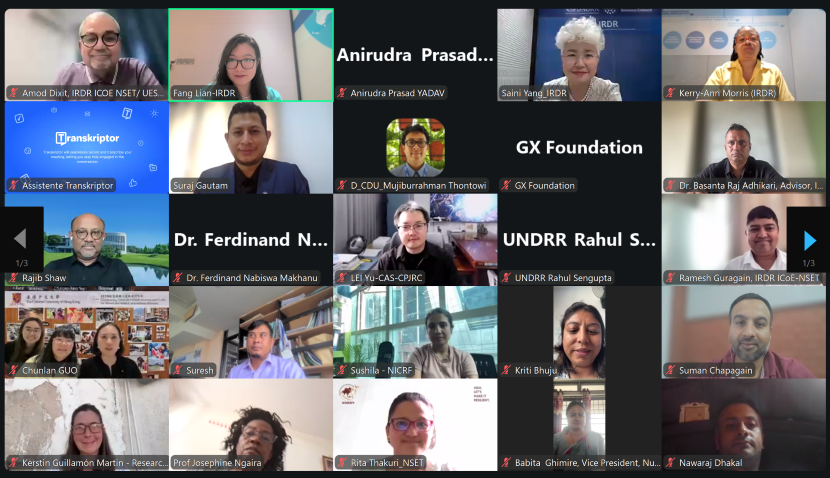
A screenshot of some of the participants during the webinar
A panel of senior scientists from the IRDR network and partner organisations highlighted critical systemic weaknesses exposed by the disaster.
The problem of isolated science and policy: The panel noted that while Nepal has developed capacity for earthquakes and typical riverine floods, this event demonstrated a fundamental gap in understanding high-mountain cryospheric hazards. Hazards such as glacial lake outburst floods (GLOFs), ice avalanches, and permafrost degradation are studied in isolation, with a pressing need for an integrated, multi-hazard risk assessment approach.
Weak science-policy interface: Despite clear scientific warnings about compounding risks in the Hindu Kush Himalaya—including in the IPCC's Sixth Assessment Report—the translation of this knowledge into urgent policy action and community-level preparedness remains severely lacking. The gap between "understanding risk" and "acting on risk" remains a central challenge.
The need for a Himalayan Monitoring Centre: Experts proposed establishing a regional monitoring center bringing together China, India, Nepal, Pakistan, and Bhutan to facilitate collaborative real-time monitoring, data analysis, and risk-sensitive land-use zoning.
The "Bordered" Nature of Monitoring Systems
The disaster starkly illustrated the "borderless" nature of such hazards and the "bordered" nature of monitoring systems, data, and institutional responsibility. There is currently no formal mechanism for real-time data sharing on transboundary hazards. While bilateral frameworks exist, they are often passive and slow to operationalize.
Experts called for a shift from informal, emergency-only communication to a permanent system with established protocols for sharing "minimal critical information" rather than raw, often sensitive, data. The initial scientific analysis provided by Chinese authorities was instrumental in helping Nepal understand the disaster's trigger mechanics, demonstrating the value of sharing risk information as a practical starting point.
The panel emphasized that the current framework must evolve from passive data sharing to an active joint monitoring network combining remote sensing with collaborative real-time analysis.
Health Impacts Extend Far Beyond Mortality
Prof. Emily Chan, Director of the Collaborating Centre for Oxford University and CUHK (CCOUC) for Disaster and Medical Humanitarian Response (CCOUC), the host institute for IRDR ICoE-CCOUC, brought a critical public health perspective, emphasizing that the disaster's impact extends far beyond immediate mortality.
The event created a mixture of health implications typical of floods, mudslides, and earthquakes, including crush syndrome, wound infections, and hypothermia. The high-altitude context further complicates response due to the malfunctioning of standard medical equipment at high altitudes.
Rescue, relief, and lifeline infrastructure workers face significant secondary risks from unstable terrain, floodwaters, and debris. Disaster-affected populations, particularly those who have lost entire families, face profound mental health and social challenges. Support must be sensitive, long-term, and involve community-based organizations, with the needs of the most vulnerable—including the elderly and children—prioritized.
Recommendations and the Way Forward
Based on the discussion, webinar participants identified concrete recommendations to enhance transboundary disaster risk reduction.
Establish a Himalayan Monitoring Centre: Create a regional platform involving all Himalayan nations and international partners to monitor cryospheric hazards, conduct joint research, and share data.
Develop an International Data-Sharing Protocol: Move beyond informal agreements to establish a formal, operational protocol for sharing "minimal critical risk information" during and immediately after transboundary events, specifying focal points, communication channels, and response timelines.
Conduct a Forensic Investigation of Disasters (FORIN): IRDR and partners should conduct a detailed FORIN study of the 26 August event to identify not just physical causes but also underlying social, economic, and policy drivers of vulnerability and exposure.
Enhance Scientific Capacity for Multi-Hazard Risk Assessment: Support Nepal and other Himalayan nations in building capacity for integrated, multi-hazard risk assessments that consider the complex interactions between glaciers, permafrost, landslides, and climate change.
Integrate Health into Risk Reduction Strategies: Develop and disseminate clear guidelines for managing health implications, including occupational safety for responders, mental and social health support, and long-term health needs of vulnerable populations.
A Defining Moment for the Region
The webinar concluded that the 26 August 2026 flash flood was a tragic and defining moment for the Himalayan region. It has forcefully underlined the complex, cascading, and transboundary nature of modern disaster risk. The disaster is not an isolated event but a stark indicator of a changing regional risk profile, driven by global warming and climate change.
The collective scientific response and collaborative spirit of the webinar highlight that a more integrated, proactive, and transboundary approach to risk management is not just an aspiration but an urgent necessity for building resilience and saving lives in the region.
The event concluded with an open floor Q&A and wrap-up remarks by IRDR's Executive Director, outlining next steps for translating the workshop's insights into actionable policy and operational recommendations.