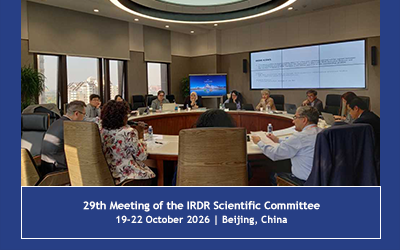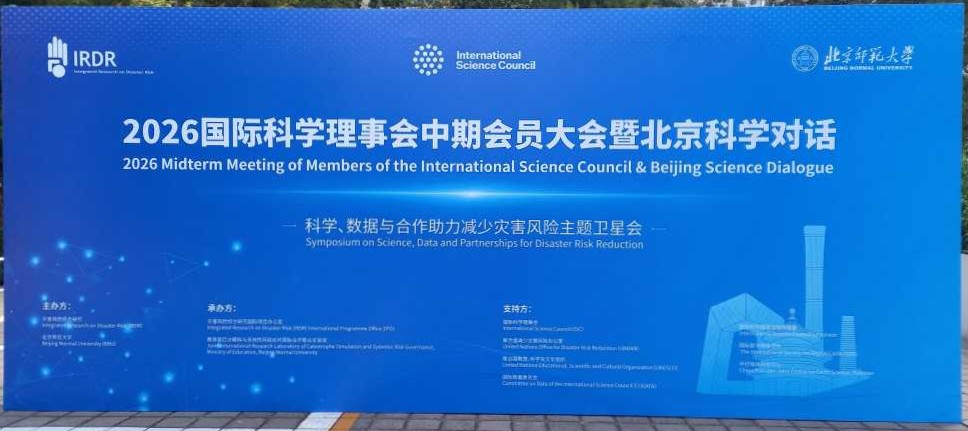
The IRDR Satellite Symposium "Science, Data and Partnerships for Disaster Risk Reduction" opened on 20 October 2026 in the Yingdong Conference Hall at Beijing Normal University, held alongside the 2026 Midterm Meeting of Members of the International Science Council and the Beijing Science Dialogue.
Speaking at the opening of the satellite symposium, Peter Gluckman, President of the International Science Council (ISC), urged the community to "use disaster risk science as a form of science diplomacy". He emphasized that IRDR, a very important affiliate body within the ISC, sits at the heart of that effort, connecting scientific inquiry with the practical task of reducing disaster risks. His call framed the day's discussions and anchored the satellite symposium firmly within the wider Beijing Science Dialogue—an ISC event convening the global scientific community. For Gluckman, disaster risk science is not only a tool for better decision-making but a means of bridging science and policy across borders.
The opening session, chaired by Ming Wang, Vice-President of Beijing Normal University (BNU), featured welcoming remarks from Jihong Yu, President of BNU; Peter Gluckman, President of the ISC; and Marco Toscano-Rivalta, Head of the Regional Office for Asia and the Pacific, United Nations Office for Disaster Risk Reduction (UNDRR). A launch session followed, led by Saini Yang, IRDR's Executive Director. Together, the welcoming remarks set the tone for the day—calling for open, interdisciplinary exchange and a stronger role for disaster risk science in policy and diplomacy.
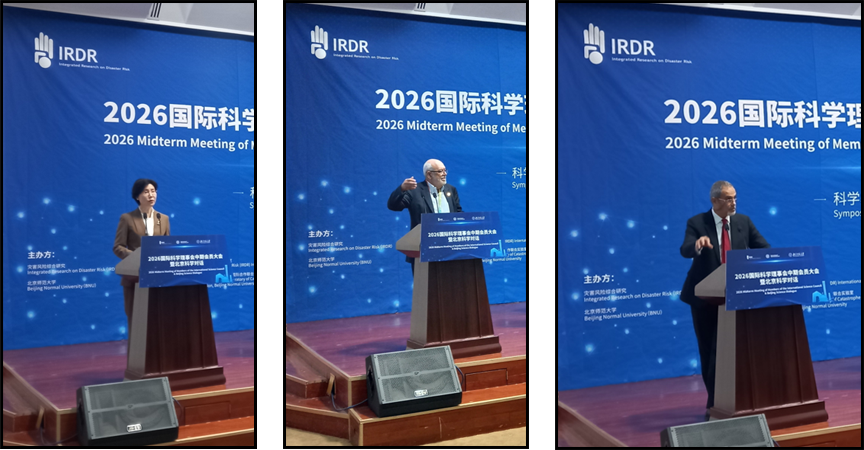
(l-r) Welcoming remarks were provided by Jihong Yu, President of BNU; Peter Gluckman, President of the ISC; and Marco Toscano-Rivalta, Head of the UNDRR's Regional Office for Asia and the Pacific.
Open, convivial exchange as the symposium's operating spirit
The opening remarks called for free idea exchange without judgment or barriers, with the generosity and humility to question assumptions and learn from one another. This spirit underpins the deliberate interdisciplinary scope of the four panels: the Economics of Disasters and Disaster Risk Reduction; Data and Technology for Disaster Risk Reduction; Climate Change and Disaster Risk Reduction; and Systemic, Compound and Cascading Risks.
Responsible science and the journey from research to wisdom
Speakers stressed that as science becomes increasingly central to policy, it carries a duty to engage with its methods, limitations, and findings. Decision-makers should use the best available science while staying ready to reconsider as understanding evolves—moving from research to knowledge, and from knowledge to wisdom, through reflection on experience and consequences. A central challenge raised was holding the particular and the general together: general models reveal patterns across places, but local experience redefines what "normal" means, requiring sustained dialogue between natural science and social sciences, psychology, and humanities.
Harmonizing action, investment, and a culture of prevention
The opening remarks cast international cooperation as a matter of harmonizing—not homogenizing—the actions of nations, achievable only on the basis of scientific knowledge, wisdom, and good will. This requires patience in building a wider public culture of prevention. Critically, governments—especially those who do not yet understand—must be helped to see the need to invest in DRR now: resilience can be built now to reduce damage from events like earthquakes. With three years left to implement the Sendai Framework, the opening remarks stressed that much work remains to convert research into wiser disaster risk reduction decisions.
Bringing these themes together, the full-day satellite symposium gathered leading researchers, policymakers, and practitioners from across the globe to examine how scientific knowledge, data, and international research partnerships can strengthen disaster risk reduction (DRR) in a rapidly changing world.
Organizers and Support
The satellite symposium is organized by IRDR and Beijing Normal University, with support from the ISC, the United Nations Office for Disaster Risk Reduction (UNDRR), the China Association for Science and Technology (CAST), the Chinese Academy of Sciences (CAS), and numerous international scientific unions.
The agenda for IRDR's Satellite Symposium is available here: https://www.irdrinternational.org/upload/20261016/7b80dece82a026.pdf
For more information about the 2026 Beijing Science Dialogue and the ISC Midterm Meeting of Members, visit the ISC website: https://council.science/mmm-beijing-science-dialogue/