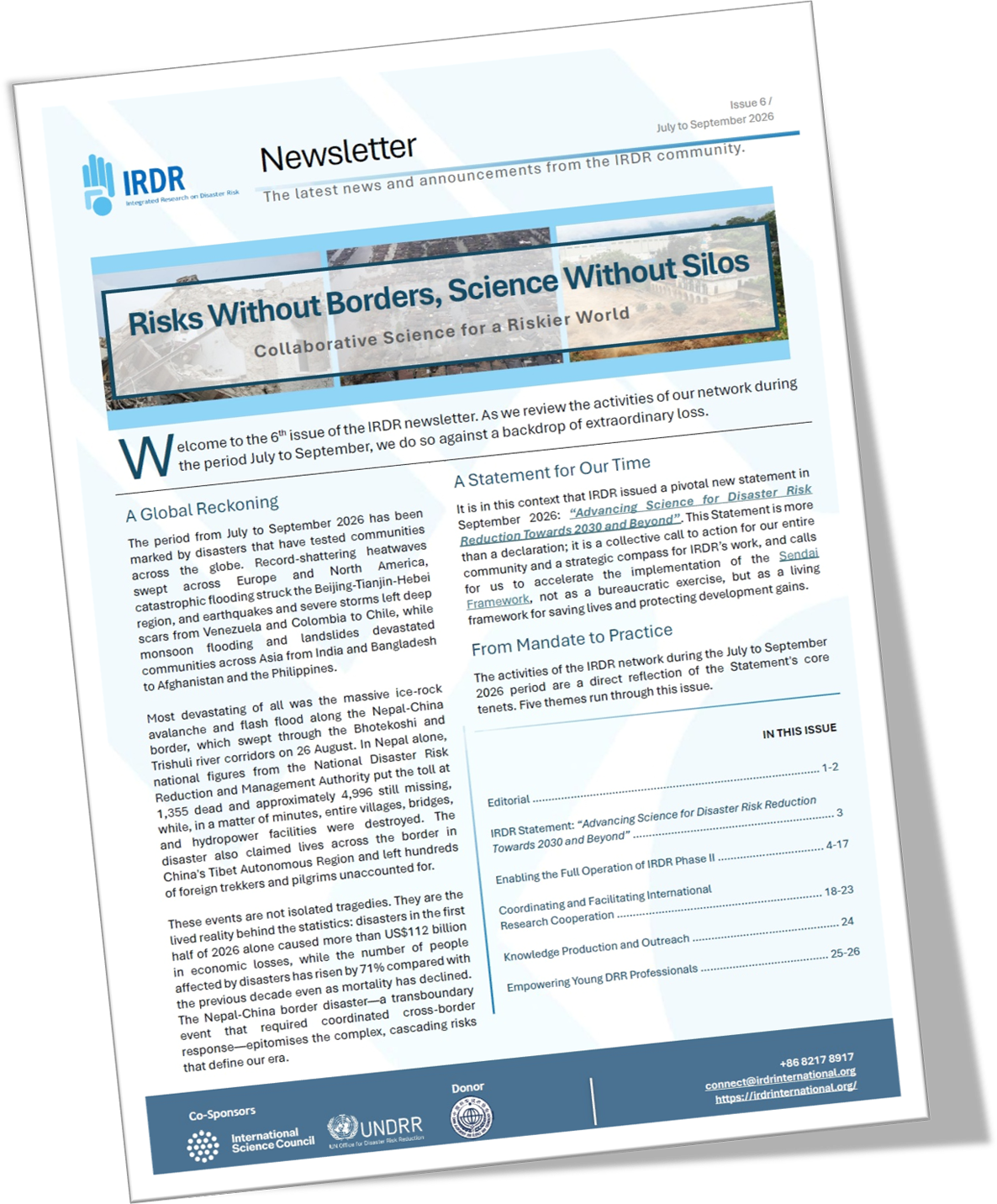
The IRDR IPO has released the sixth issue of IRDR's Phase II newsletter, covering the period July to September 2026. Under the theme "Risks Without Borders, Science Without Silos", this edition arrives against a backdrop of extraordinary loss—and a renewed call to action.
A Quarter of Reckoning
Record heatwaves, catastrophic flooding from Beijing to Bangladesh, and earthquakes across South America defined the period. Most devastating was the 26 August ice-rock avalanche and flash flood along the Nepal-China border, which killed 1,355 people in Nepal alone, with nearly 5,000 still missing. Entire villages and hydropower facilities were destroyed in minutes.
A Pivotal Statement
Against this backdrop, IRDR issued a pivotal new statement in September 2026: "Advancing Science for Disaster Risk Reduction Towards 2030 and Beyond." The statement serves as a collective call to action and a strategic compass for the IRDR network, urging the community to accelerate the implementation of the Sendai Framework as a living framework for saving lives and protecting development gains.
Five Themes of Action, One Mission
The newsletter highlights five key themes reflecting the Statement's core tenets:
Expanding the Network: IRDR welcomed five new International Centres of Excellence (ICoEs) in July, anchoring Southeast Asia, the Himalayan region, Eastern Europe, East Africa, and Southern Africa. The issue reports on the official launches of three: IRDR ICoE-PREPARE in Bucharest, IRDR ICoE-IDR at Loughborough University, and IRDR ICoE-IHRR in Nepal.
Rapid, Actionable Science: Following the China-Nepal border mudslide, IRDR published a Rapid Disaster Impact Report on 29 August using satellite remote sensing. IRDR ICoE-IHRR and IRDR Young Scientists in Nepal mobilised a rapid scientific investigation within hours, identifying a high-elevation ice-rock soil mass failure as the likely trigger and highlighting critical gaps in rainfall-dependent warning systems.
Transboundary Science-Policy Dialogue: On 3 September, IRDR partnered with the United Nations Office for Disaster Risk Reduction (UNDRR) to convene a virtual workshop dissecting the China-Nepal border event. Experts called for integrated early warning systems, a dedicated Himalayan Monitoring Centre, and formal cross-border data-sharing protocols.
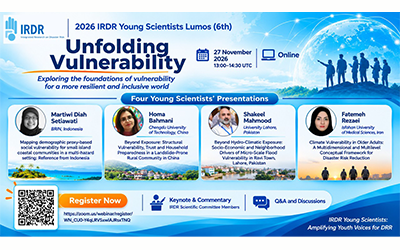
Cultivating the Next Generation: The 2026 joint Beijing Normal University (BNU)-IRDR Summer School brought together 43 early-career researchers from 25 countries to explore the links between governance, development, and disaster risk. The issue also highlights IRDR Young Scientists driving rapid research, including two colleagues awarded UK DARe Impact Fellowships.
Advancing the Science-Policy-Practice Interface: On 1 September, the IRDR Climate Change and Public Health webinar connected researchers across the network. The issue also features the IRDR ICoE-IHRR launch in Nepal, which brought together government, DRR networks, academia, civil society, and media, and the new Science Council of Japan (SCJ) recommendations on disaster-resilient megacities, now published in English for international dissemination.
Looking Ahead
"Risks do not respect borders, and our science must not respect silos," the editorial states. As the community moves towards 2030, the path is clear: from evidence to action, from siloed research to integrated collaboration, and from reacting to disasters to anticipating them.
The full Issue 6 newsletter is available here.