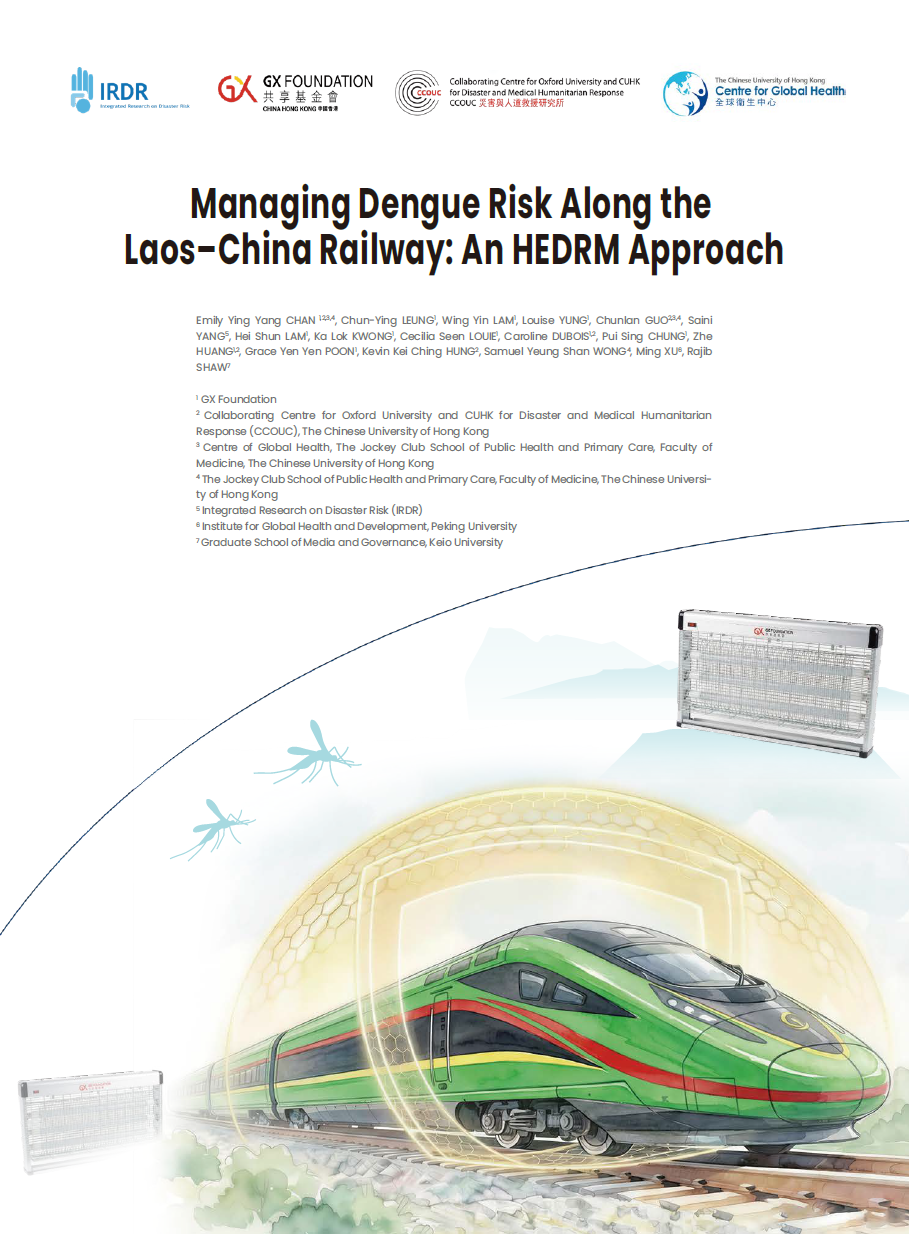
The IRDR ICoE-CCOUC Special Report, "Managing Dengue Risk Along the Laos-China Railway: An HEDRM Approach," provides a blueprint for integrating public health surveillance with disaster risk reduction in linear infrastructure projects (e.g., transportation corridors). The Special Report documents a pioneering dengue risk management intervention along the Laos-China Railway, a major transportation corridor where high human mobility inherently increases the risk of vector-borne disease transmission. The intervention itself was designed and implemented by the GX Foundation of Hong Kong. IRDR ICoE-CCOUC worked in close partnership with the GX Foundation on this project, and the report serves as a scholarly documentation of the Foundation's on-the-ground efforts.
Using the Health Emergency and Disaster Risk Management (HEDRM) framework as its analytical lens, the Special Report examines the outcomes of the GX Foundation's targeted "physical means" vector control package—including mosquito-killing lamps, bed nets, and rapid test kits—deployed at railway stations and staff facilities along the corridor.
Key documented outcomes from the project include:
Zero staff dengue infections reported in the 12 months following the initial intervention.
Documented, visible entomological impact on mosquito populations along the corridor.
Strong endorsement from both railway personnel and local communities regarding the usability of the equipment.
"This special report is timely and warranted because dengue activity in Southeast Asia remains high. Laos experiences recurrent outbreaks, and transport corridors can amplify spread, yet practical, cross-sector examples of HEDRM embedded within railway operations are scarce. By documenting the HEDRM approach—including the humanitarian work conducted by the GX Foundation for the Laos-China Railway—we provide actionable evidence on how health and transport partners can jointly reduce vector-borne risks, safeguard staff and travellers, maintain continuity of operations, and strengthen system resilience along a strategic cross-border corridor." (pg. 2 of the Special Rreport)