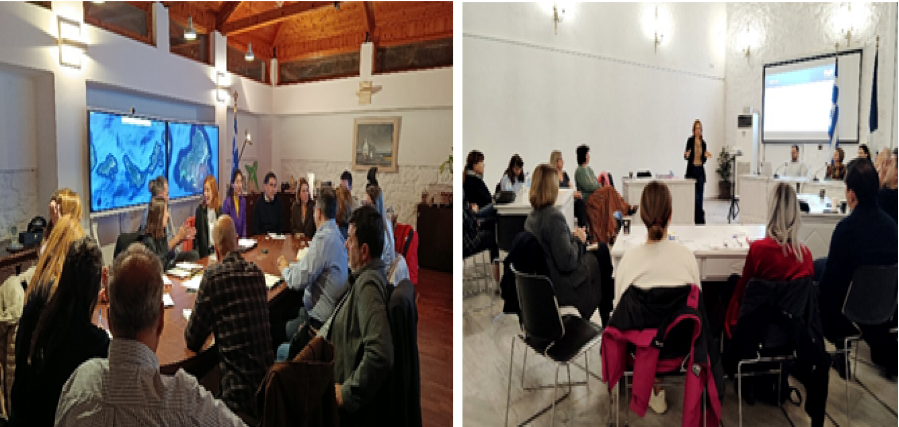
The REACT project team introducing the project objectives and approach during the field visit to Skiathos. (Source: IRDR ICoE RE&SRT)
Extreme weather events are becoming more frequent, more destructive and more harmful as climate change accelerates, particularly for vulnerable communities. In Greece, these changing threats underline the need for a shift from just responding to emergencies to fully involving the community in disaster risk management that is preventive and deeply rooted at
the local level.
To address this challenge, the Integrated Research on Disaster Risk (IRDR) programme’s newly established International Centre of Excellence (ICoE) in Greece, the IRDR ICoE in Resilience Economics and Sustainable Risk Transitions (IRDR ICoE RE&SRT), has initiated a new project that is taking a community-driven approach, education and action based on local realities to help communities become more climate-resilient and to better prepare for disasters. Launched in 2025 and running until 2027, the Resilience, Education and Action for Climate Transformation (REACT) project focuses on the Greek island of Skiathos and offers a strong focus on the community as the key element of resilience, together with education, local citizen engagement, and the clever use of tools.
The project is funded by the Green Fund, a public-law entity reporting to the Greek Ministry of Environment and Energy, and is being scientifically led by Associate Professor Stella Tsani of the Department of Economics, the host institute for IRDR ICoE RE&SRT, at the National and Kapodistrian University of Athens.
Skiathos as a living laboratory for participatory resilience
The island of Skiathos serves as the focal point for REACT’s activities. Its geographic isolation, limited infrastructure, pronounced seasonal population fluctuations, and active participation in climate change initiatives increase both its exposure to climate-related hazards and its willingness to learn. These characteristics make Skiathos a representative case for many small and resource-constrained communities, positioning it as a living laboratory for testing participatory approaches to disaster preparedness.
The project was initiated by conducting a thorough assessment of local vulnerabilities, needs and capacities. Questionnaires were distributed to local authorities, key stakeholders and students, which helped to include a wide range of perspectives in the process. The assessment was based on the Disaster Resilience Scorecard for Cities developed by the United Nations Office for Disaster Risk Reduction, which provided a framework for analysis and helped to align the results with globally recognised resilience indicators.
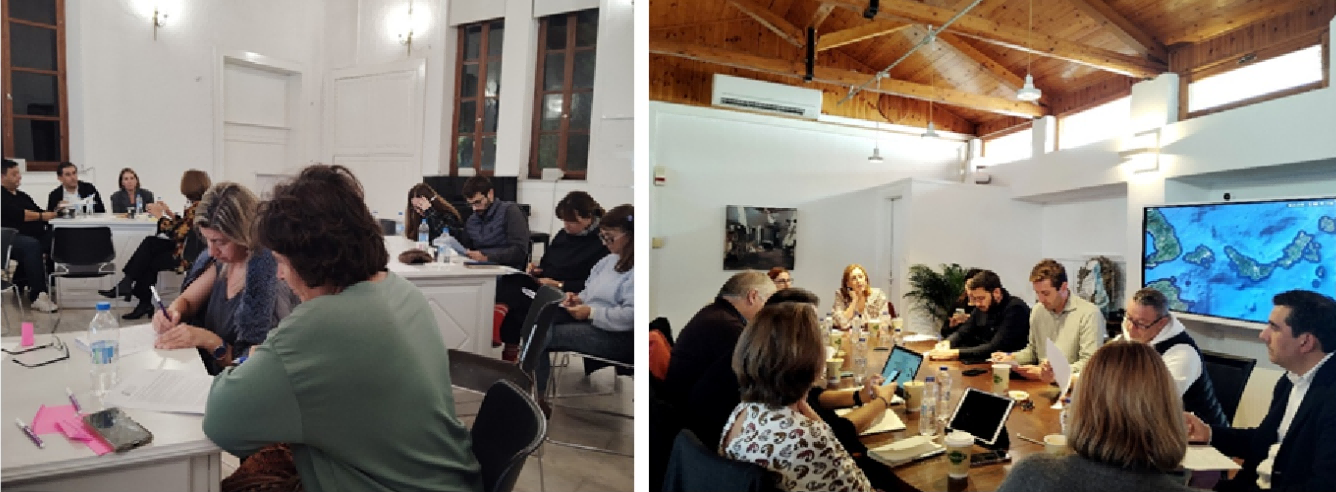
Engaging local stakeholders through questionnaires during REACT’s initial assessment phase in Skiathos. (Source: IRDR ICoE RE&SRT)
From evidence to action: education, communication, and youth leadership
Building on the assessment of the findings, REACT focuses on three interconnected pillars: strategic risk communication, education for emergency preparedness, and active youth engagement. These pillars will be translated into concrete actions, including interactive seminars on climate change and disaster prevention, as well as train-the-trainer programmes that increase the local capacity and guarantee long-term sustainability beyond the project’s duration.
Key takeaways for the IRDR Network of ICoEs
· Operationalising the Sendai Framework locally
REACT demonstrates how Sendai priorities can be translated into action at the community level, bridging global policy commitments with local implementation.
· Participatory risk assessments
The use of tools that are internationally recognised in a community-based setting. Other ICoEs can adapt this approach to strengthen local ownership of DRR strategies.
· Capacity development through education
The central role of education behind behavioural changes and preparedness. Through the train-the-trainer model, a local community can be equipped with long-term capacity in a way that can be duplicated.
· Youth engagement for sustainable resilience
Involving young people as active contributors to resilience efforts are not only a great support to inclusive development but also can guarantee intergenerational continuity of such efforts.
· Context-specific solutions for vulnerable settings
The need to tailor DRR strategies according to the local geographical and social conditions. Lessons from the Skiathos case are relevant to islands and communities with limited infrastructure, making the project relevant to IRDR ICoEs working in similarly vulnerable contexts.
The project therefore offers practical lessons and transferable best practices relevant to DRR initiatives worldwide. REACT is also firmly aligned with national, European, and international frameworks, including the Sendai Framework for Disaster Risk Reduction, 2015-2030. This alignment ensures that global guidance becomes concrete, locally relevant action, where resilience is eventually built and sustained.
For more information about the REACT project contact Dr. Stella Tsani, Associate Professor, stsani@econ.uoa.gr.