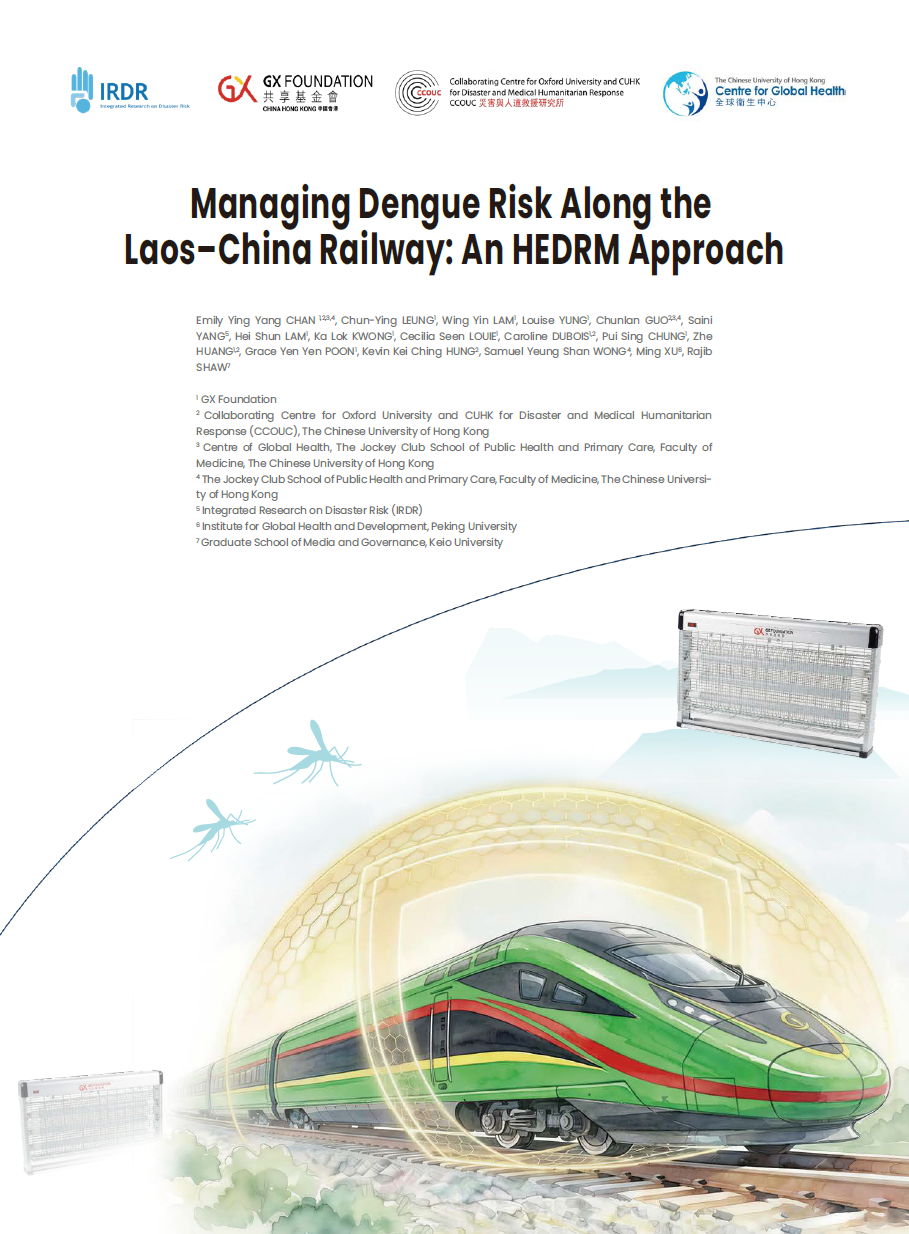
On the opening day of the 79th World Health Assembly (WHA79), the IRDR International Centre of Excellence for the Collaborating Centre for Oxford University and the Chinese University of Hong Kong (CCOUC) for Disaster and Medical Humanitarian Response (IRDR ICoE-CCOUC) launched its latest Special Report, "Managing Dengue Risk Along the Laos-China Railway: An HEDRM Approach." The launch took place during the official WHA79 side event, "Keep It Simple – No Mosquito, No Dengue", hosted by the GX Foundation at the InterContinental Geneva in Switzerland.
The side event convened global health leaders, including Mr. Chun-ying LEUNG, Vice-Chairperson of the National Committee of the Chinese People's Political Consultative Conference (CPPCC) and Chairman of the GX Foundation, and Prof. Shen Hongbing, Vice Minister of the National Health Commission and Head of the National Disease Control and Prevention Administration, China. The gathering underscored the urgent need for sustainable, community-based solutions to combat dengue, a disease that has seen a tenfold increase globally over the last two decades.
Documenting a Partnership-Driven Intervention
The newly launched Special Report—authored and released by IRDR ICoE-CCOUC—documents a pioneering dengue risk management intervention along the Laos-China Railway, a major infrastructure corridor where high human mobility inherently increases the risk of vector-borne disease transmission. The intervention itself was designed and implemented by the GX Foundation of Hong Kong. The IRDR ICoE-CCOUC worked in close partnership with the GX Foundation on this project, and the report serves as a scholarly documentation of the Foundation's on-the-ground efforts.
Using the Health Emergency and Disaster Risk Management (HEDRM) framework as its analytical lens, the Special Report examines the outcomes of the GX Foundation's targeted "physical means" vector control package—including mosquito-killing lamps, bed nets, and rapid test kits—deployed at railway stations and staff facilities along the corridor.
Key documented outcomes from the project include:
Zero staff dengue infections reported in the 12 months following the initial intervention.
Documented, visible entomological impact on mosquito populations along the corridor.
Strong endorsement from both railway personnel and local communities regarding the usability of the equipment.
Prof. Saini Yang, IRDR’s Executive Director, reaffirmed the organization’s commitment to disseminating these findings. "The IRDR community can learn from these experiences and promote this application within their own countries," Prof. Yang noted during a high-level meeting held prior to the WHA79 side event, emphasising the project as an effective example of integrating health protection into national DRR strategies.
A "Chinese Solution" for Global Health
The WHA79 side event highlighted the scalability of the "physical means" approach championed by the GX Foundation, which has been published in The Lancet. Unlike chemical interventions, these tools offer a sustainable, cost-effective method for resource-limited settings.
The discussion at the side event featured high-level representatives from Laos, Cambodia, East Timor, and Vanuatu, who shared their experiences with similar physical prevention and control strategies. The IRDR ICoE-CCOUC's report serves as a critical case study for policymakers, proving that HEDRM is not just a theoretical framework but a practical tool for managing biological hazards in an era of increasing global mobility and climate change.
About the Report
IRDR ICoE-CCOUC's Special Report, "Managing Dengue Risk Along the Laos-China Railway: An HEDRM Approach," produced in partnership with the GX Foundation, is now available on the IRDR website. It provides a blueprint for integrating public health surveillance with disaster risk reduction in linear infrastructure projects.
For more information or to download the report, please visit: https://irdrinternational.org/knowledge_pool/publications/141