(Click to enlarge image)
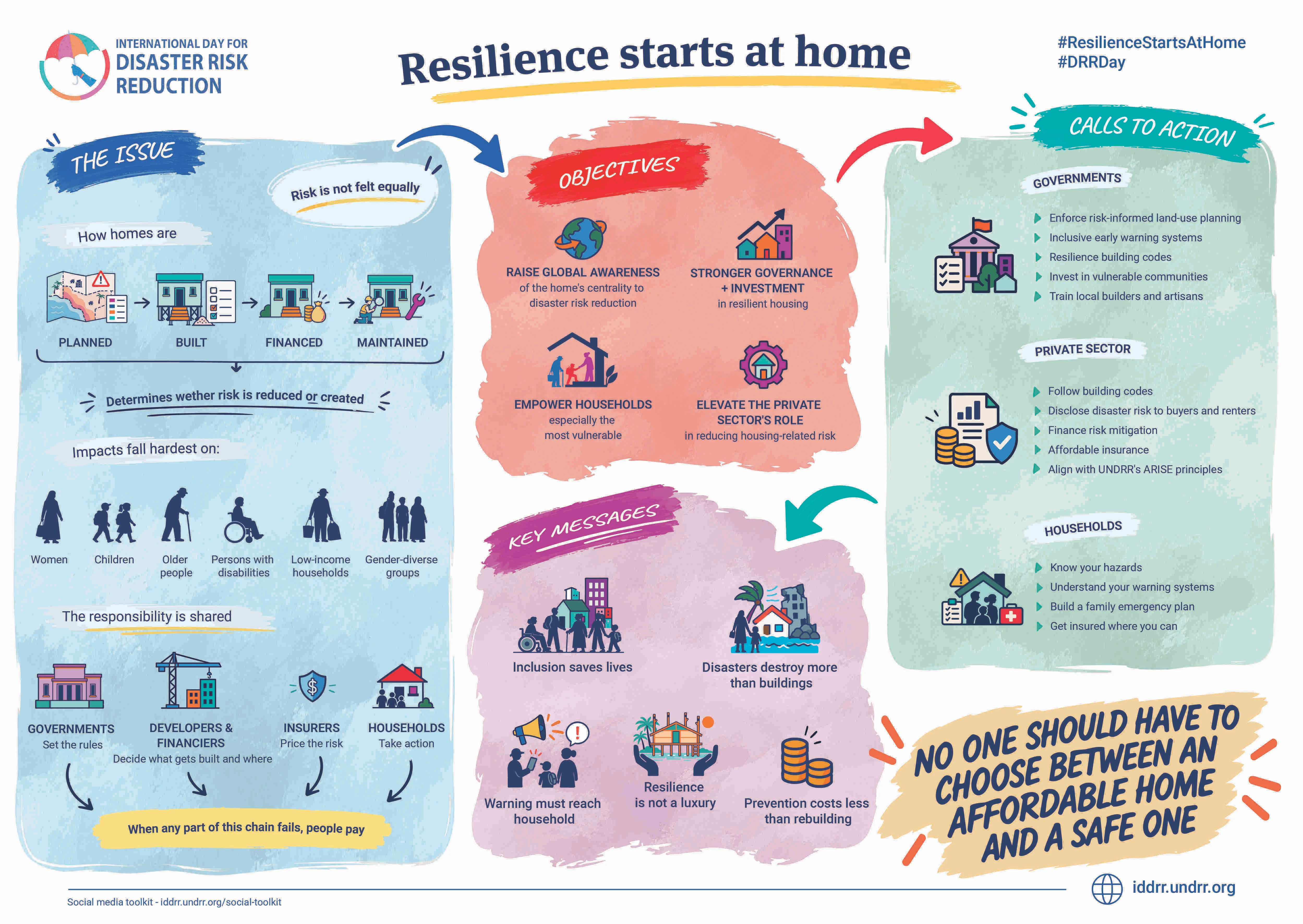
The Integrated Research on Disaster Risk (IRDR) programme today joins its co-sponsor, the United Nations Office for Disaster Risk Reduction (UNDRR), in observing the International Day for Disaster Risk Reduction (IDDRR) 2026 under the theme “Resilience Starts at Home”.
The theme highlights the household as both the front line of disaster impacts and the starting point for effective risk reduction, reflecting the people-centred focus of the Sendai Framework. It also aligns with the 13th session of the World Urban Forum (WUF13) and Sustainable Development Goal 11, reinforcing the connection between resilient housing and broader urban resilience. It recognises that the ability of households to act on early warnings is shaped by access to information, resources, and decision-making power — capacities that are often unevenly distributed.
The 2026 campaign draws attention to the gap between early warnings and protective action — an area where IRDR’s recent work has been directly engaged. Findings from the Lloyd’s Register Foundation World Risk Poll 2026 report, *Alert to Agency*, show that while four in five people who experienced a disaster received a warning, only 64% could act on it. Among those warned, 83% with both a household disaster plan and a sense of personal agency took action — compared with just 27% of those with neither.
Over the past six years, IRDR has worked to place this warning-to-action gap at the centre of the global research agenda. In 2019, the International Science Council (ISC) and UNDRR invited IRDR to lead development of A Framework for Global Science in Support of Risk-informed and Sustainable Development and Planetary Health. Drawing on more than 80 experts, the ISC-UNDRR-IRDR Glable Research Famework — launched at the IRDR 2021 Conference and issued at the ISC General Assembly later that year — sets out how risk science, including early warning information, can be translated into decision-making at all scales. This Framework now serves as the foundation of IRDR Phase II, formally launched in 2023, which mobilises science to reduce disaster risk by integrating risk research with climate adaptation and sustainable development.
As a co-sponsored programme of the ISC and UNDRR, IRDR reaffirms its commitment to mobilising science for disaster risk reduction and advancing research that translates risk information into action. The 2026 IDDRR theme resonates deeply with IRDR’s mission to strengthen the scientific and technical capacity of disaster risk reduction — particularly in understanding how risk information translates into action at the most fundamental level of society: the household.
UNDRR, supported by Switzerland, is organising events in Geneva from 13–15 October, and partners worldwide are invited to amplify the message using #ResilienceStartsAtHome and #DRRDay.