A new PreventionWeb "DRR Community Voices" blog by IRDR Fellow, Dr. Bapon Fakhruddin, argues that local preparedness alone cannot compensate for the development, infrastructure, and investment decisions that systematically create and redistribute disaster risk.
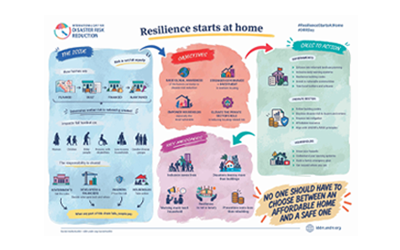
As the 2026 International Day for Disaster Risk Reduction (IDDRR) highlights the theme "Resilience Starts at Home," Dr. Fakhruddin's article offers a timely and challenging perspective: while household preparedness matters, many of the conditions that determine whether preparedness is effective are shaped far from home—through decisions about land use, infrastructure, public services, and investment.
The Limits of Local Preparedness
The blog makes a compelling case that communities are not passive recipients of risk. Residents identify vulnerabilities, interpret warnings, and mobilise assistance. However, Dr. Fakhruddin cautions against conflating the location of disaster impacts with responsibility for producing them.
"When resilience is framed primarily as a matter of household preparedness, institutions can evade responsibility for the land-use, infrastructure, regulatory, and financial decisions that determine whether preparedness is effective," he writes.
The article introduces the Local-to-Systemic Risk Governance framework, which distinguishes three critical processes: risk creation (when decisions alter hazards, exposure, or vulnerability), risk transmission (when disruption spreads through interconnected systems), and risk bearing (who ultimately experiences losses). These processes often involve different actors, with those who benefit from development decisions frequently not being those who absorb the associated risks.
Matching Responsibility with Authority
Drawing on the Sendai Framework, the article emphasises the challenge of translating broad commitments into institutional authority. Dr. Fakhruddin proposes financed local resilience compacts as a governance mechanism linking local responsibilities with defined decision rights, predictable financing, and accountable institutional support. The article also calls for investment appraisal processes that assess future exposure and the distribution of potential gains and losses beyond immediate project boundaries.
Participation and Accountability
The blog argues that participation must extend beyond consultation about household preparedness. Communities should be able to influence upstream decisions through which exposure and vulnerability are produced. Accountability should extend from investment and preparedness through warning and recovery, with disaggregated assessment essential to identify populations and places where protection remains incomplete.
A Framework for the Future
As the Sendai Framework approaches its 2030 conclusion, Dr. Fakhruddin's article offers a vision for global risk governance beyond 2030—one that places greater emphasis on whether governance, financing, and investment decisions reduce the production and unequal distribution of risk.
"Resilience is experienced locally, but it is not produced locally alone," he concludes.
Read the full article on PreventionWeb: From local resilience to systemic risk governance.
Dr. Bapon Fakhruddin is an award-winning global expert in climate resilience and climate finance with over 25 years of experience. He leads the Water Sector at the Green Climate Fund and is an AsiaGlobal Fellow at the Asia Global Institute, The University of Hong Kong. He also served as an IRDR Scientific Committee (SC) member during its first phase. For further details, visit his LinkedIn page: https://www.linkedin.com/in/bapon/ and personal website: https://ww.shmfakhruddin.net.