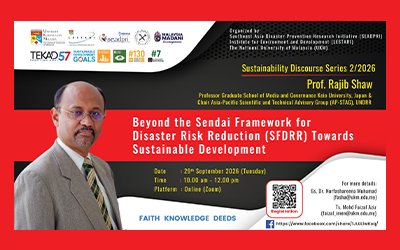
Rajib Shaw, Executive Director of IRDR.
Previously, Shaw was a Professor in the Graduate School of Global Environmental Studies of Kyoto University, Japan. He has extensive experience in disaster risk reduction (DRR) research and has worked closely with local communities, NGOs, governments and international organizations in Asia. His research expertise includes community-based disaster risk management, climate change adaptation, urban risk management, and disaster and environmental education. He is the editor of a book series on disaster risk reduction, published by Springer, and is Co-chair of UN ISDR’s Asia Science Technology Academic Advisory Group (ASTAAG). Shaw has published extensively in scientific journals and books.
“We are delighted to welcome Rajib Shaw to lead the programme office of IRDR. Under his leadership, the programme will move to a new phase fostering an integrated approach to disaster science and strengthen its impacts on policy and practice. His appointment is especially timely as it coincides with a thorough review of the programme,” said Heide Hackmann, Executive Director of the International Council for Science, co-sponsor of the programme.
“We congratulate Rajib Shaw on his appointment and we look forward to working closely with him to make IRDR a success. As disasters and their impacts continue to increase around the world, we need to bring together scientists across disciplines, policy-makers and practitioners, bring DRR into development planning and shift focus from response to risk management and risk prevention. This is the major focus of IRDR. Shaw’s experience in bridging science to policy, capacity development and implementation will be a major asset.” Shuaib Lwasa, Chair of the Science Committee of IRDR, added.

About Integrated Research on Disaster Risk (IRDR)
Integrated Research on Disaster Risk (IRDR) is a decade-long, interdisciplinary research programme sponsored by ICSU in partnership with the International Social Science Council (ISSC) and the United Nations International Strategy for Disaster Reduction (UN-ISDR). It is a global initiative seeking to address the challenges brought by natural hazard events, mitigate their impacts, and improve related policy-making mechanisms. http://www.irdrinternational.